Robo Race Championship
About the Competition
In Robo Race, the challenge is to design and build your own wired / wireless robot within specified dimensions, aiming to achieve maximum speed to outpace other robots on the designated track and reach the finish line in the shortest time possible.
Register NowMechatron Robo League — National 2026
Mechatron Robo League — National
India's largest school robotics championship. 5 categories, 4 age brackets.
Eligibility & Team Composition
- Robo clubs, schools, or individuals may submit nominations.
- Participants must be between 8 and 16 years of age.
- A team may consist of maximum 4 members and minimum 2 members.
- Each team must designate a team captain for communication with organizers.
Robot Specifications
Max 30 × 30 × 20 cm
Up to 6 kg
Wired or wireless
Max 12V DC
Must move in all directions
Track Specifications
- Dimensions: The arena will be approximately 14 ft x 12 ft.
- Lane Width: Each lane will be approximately 36 cm wide.
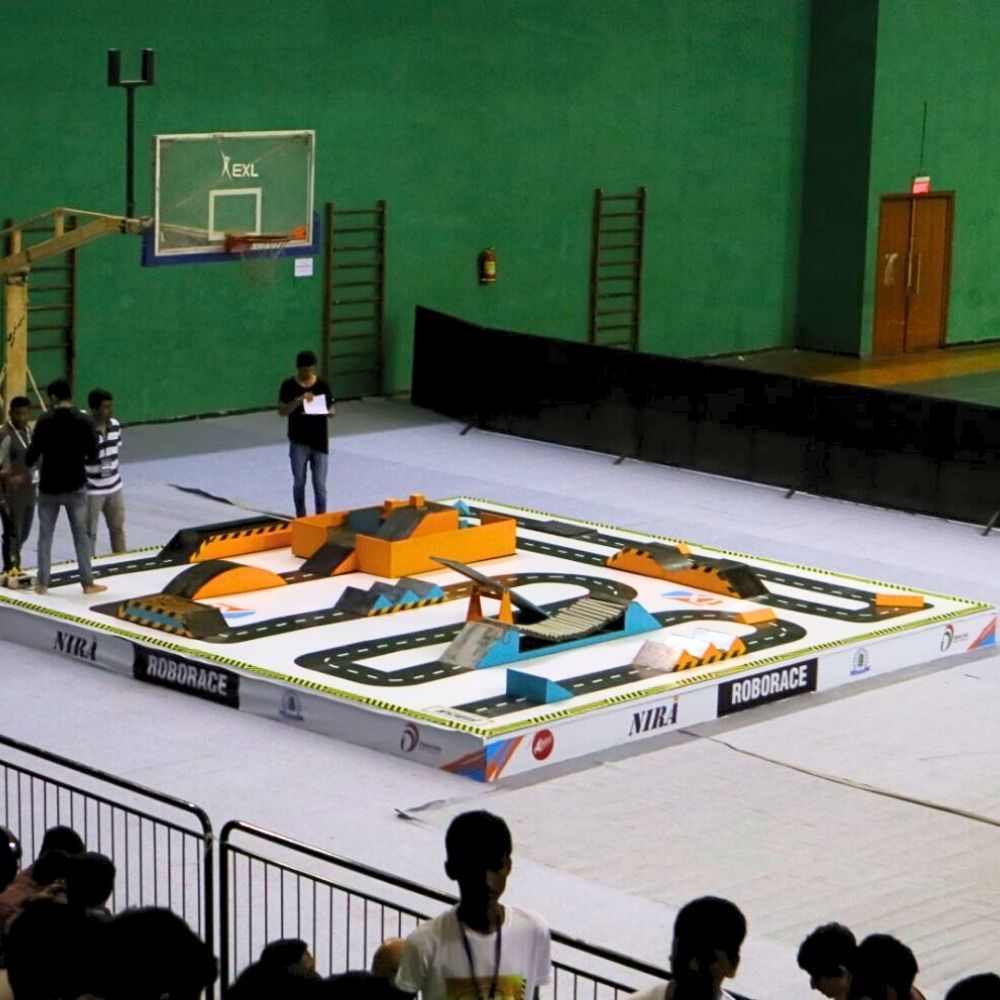
- Surface Conditions: The surface may feature unevenness and obstacles designed to slow down the robots.
- Predefined Obstacles: The competition may include various obstacles such as:
- Bridges
- Speed breakers
- Marble pits
- Slippery paths
- Curved ramps
- Seesaws
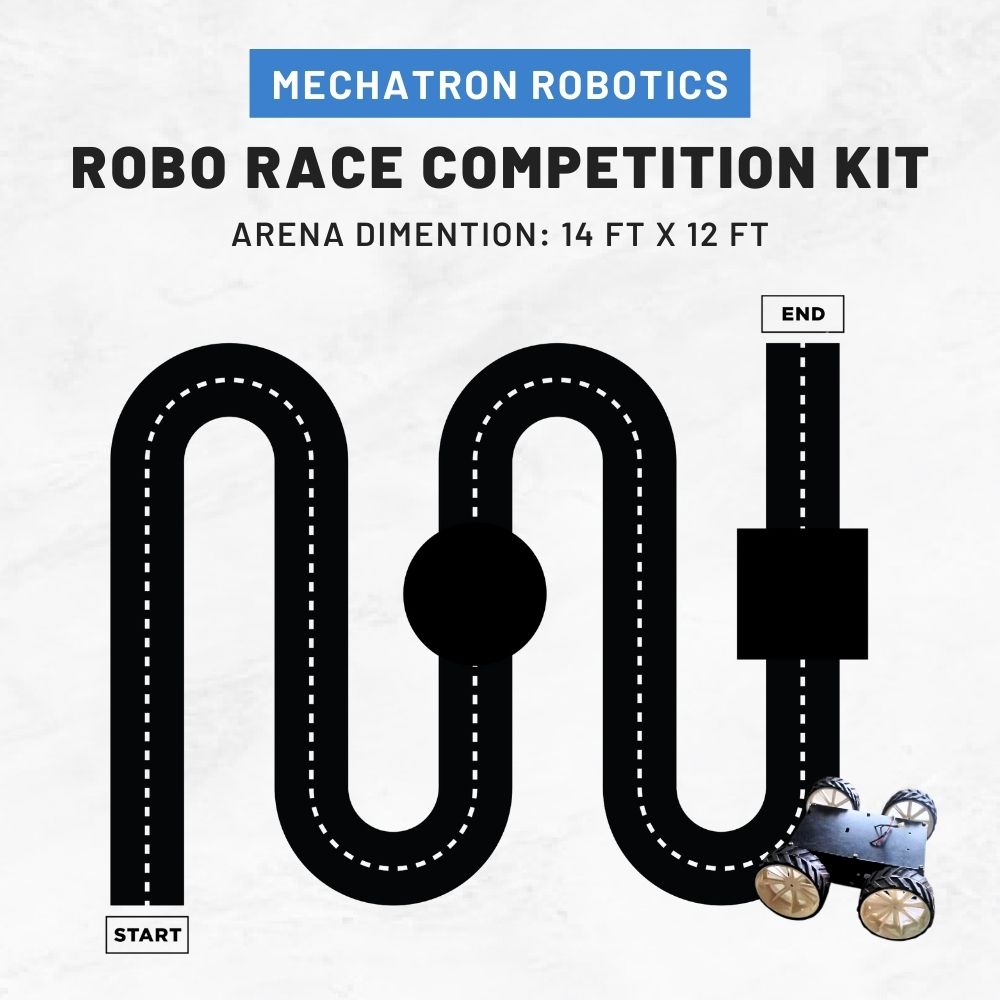
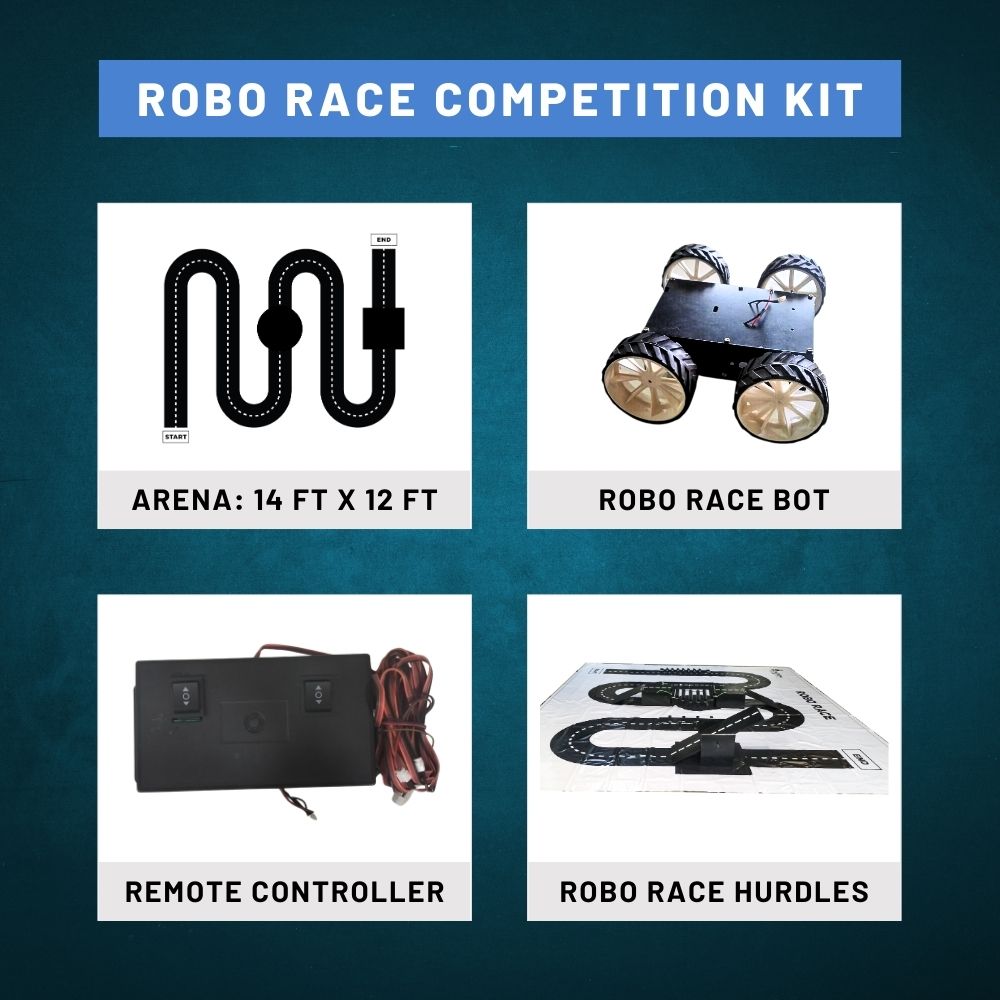
What all is included in the Competition Kit
Rules and Regulations
Start and Restart +
- Starting Point: All robots must begin from a designated starting point, with placement confirmed by the referee.
- Robot Adjustment: If a robot loses track, becomes stuck, or stops functioning, the operator may check the robot and restart it from the previous Checkpoint. Any time spent on adjusting the robot will be included in the total match time.
- Interference Claims: If a team claims that their robot has been affected by another team's robot in any way, that claim will not be considered, and the match will proceed as scheduled.
Run Time +
- The run timer will start when the front edge of the robot crosses the starting line and will stop when the front edge of the robot crosses the finish line.
Qualifying Round +
- Multiple qualifying rounds may occur based on team participation. In each round, a minimum of one team will qualify for the next round based on who reaches the finish line in the shortest time.
Final Round +
- Elimination rounds in the qualifying phase will continue until only two teams remain. The championship match occurs between these two finalists, determined by their final round results.
Points Table
- Hurdles: Each hurdle is worth 10 points.
- Special Hurdle: Completing a special hurdle with 5 tasks earns 5 points plus 25 additional points (5 tasks x 5 points each), for a total of 30 points.
- Penalties:
- Hand Touch: -2 points for each occurrence.
- Out of Track: -1 point for each occurrence.
- Skipping Hurdles: -5 points for each skipped hurdle.
- Bot Failure: -2 points plus time taken to repair.
- Chances: Teams will have 3 chances. The first chance will not yield points, and from the remaining two, the best score will be counted.
- Unfair Means: Any unfair actions will result in disqualification.
- Remote Frequencies: In the case of wireless bots, if the remote-control frequencies interfere with the opponent's, the team will be disqualified. Therefore, ensure that your control frequencies are unique.
- Final Round Scoring: In the final round, teams that reach the finish line in the shortest time will receive the highest points.
- Tiebreaker: If there is a tie, one additional chance will be given. If there is still a tie, the result will be decided by a toss.
- Winner Determination: The winner will be the team with the highest points combined with the shortest time to reach the endpoint.
Frequently asked Questions
What are the rules for team composition? +
Each team can be composed of a maximum of 4 players and a minimum of 2 players. Every team must designate a captain to communicate with the organizers.
What is the size limit for robots? +
Robots must fit within a maximum of 30 × 30 × 20 cm and weigh up to 6 kg.
What are the typical dimensions of the track? +
The arena is approximately 14 ft × 12 ft, with each lane roughly 36 cm wide.
Can the robots be controlled remotely, or do they have to be autonomous? +
Robots may be wired or wireless and are driven by an operator — they don't need to be fully autonomous. For wireless bots, ensure your control frequency is unique, as interference with an opponent's frequency leads to disqualification.
What is the power source limit for the robot? +
The robot may run on a maximum of 12V DC.
Can the robot touch or get out of track or damage the obstacles? +
These are allowed but penalised: a hand touch costs -2 points each, going out of track -1 point each, and a bot failure -2 points plus the time taken to repair. Any unfair means results in disqualification.
What is the duration of a match? +
The run timer starts when the front edge of the robot crosses the starting line and stops when it crosses the finish line — the fastest clean run wins. Teams get 3 chances; the first earns no points, and the best of the remaining two counts.
Can the robot jump or fly over obstacles? +
No. Robots must stay on the track and move across the surface in all directions to clear obstacles such as bridges, speed breakers and ramps — flying or jumping over obstacles is not permitted.
Other Competitions
More chances to compete.
Mechatron students automatically get coaching and kits to compete. Non-Mechatron teams welcome too — pay only the registration fee.
Build an AI for a real social problem in your community. Pitch + demo.
Design, build, fly. Open category — your hardware, our airspace.
Pan-African school championship across 14 partner countries.
We don't just host. We coach.
20-hour intensive with our instructors before regionals.
Sponsored kits for school teams — no out-of-pocket cost.
Stipends + booking help for teams reaching the finals.
Direct access to robotics engineers + AI researchers.